The Three Traps Every Former Athlete Falls Into
Introduction: You Didn’t Lose It
You used to compete.
Rugby. GAA. Soccer. Doesn’t matter the sport.
You were fit. Strong. Capable. You showed up even when you didn’t feel like it.
Now?
You start strong. You get sore.
You miss a session. You feel guilty. You try to restart Monday.
Three weeks later, you’re back at square one.
And you start wondering:
“Have I just lost it?” “Am I too old now?” “Where did my discipline go?”
Here’s the truth:
You didn’t lose your discipline. You didn’t lose your edge.
You’re just falling into the same three traps every former athlete falls into.
And until you recognise them, you’ll keep repeating the cycle.
The 38-Year-Old Rugby Player
A 38-year-old client came to me recently.
Played rugby at a high level in his 20s. Proper engine. Competitive mindset.
Now? Business owner. Two kids. Three years of “trying to get back into it.”
His pattern was predictable:
Train hard for two weeks
Get sore
Miss a session due to work
Feel guilty
Try to “make up for it” by going harder
Something flares up
Stop completely
Repeat.
He thought something was wrong with him.
There wasn’t.
He was trying to build a house without the bricks.
No intelligent programming. No recovery structure. No system.
Just effort.
Effort without structure collapses.
Trap 1: Training Like You’re Still 22 (The Recovery Gap)
In your 20s, you were indestructible.
Six sessions a week. Minimal warm-up. Late night. Early training. Fine.
That phase taught you something dangerous:
Push harder. Ignore discomfort. Recovery sorts itself out.
That worked then.
It doesn’t work now.
In your 30s and 40s:
You sit more
You sleep less
Stress is higher
Recovery is slower
And pretending your body still recovers like it did at 22 is exactly why you keep getting hurt.
This is the Recovery Gap.
You’re applying a 22-year-old training model to a 38-year-old nervous system.
That’s not discipline.
That’s miscalibration.
And it leads to what I call “Monday Penance” – smashing yourself to atone for the weekend.
We’re not training for next Friday.
We’re building strength for the next 30 years.

The Fix
Train for who you are now, not who you were.
You need:
– Intelligent load management – progressive overload that doesn’t break you down
– Deload weeks built in – scheduled recovery, not forced by injury
– Structured warm-ups and mobility – prep work that prevents niggles
– Recovery programmed, not hoped for – rest days are part of the plan
Training smarter isn’t softer.
It’s sustainable.
Trap 2: No External Accountability (The Motivation Myth)
When you played sport, you didn’t rely on motivation.
You relied on structure.
You had:
A coach
Teammates
A schedule
Consequences
If you didn’t show up, people noticed.
Now?
You’ve got a gym membership and good intentions.
You skip Wednesday. No one cares. You skip Friday. No one notices.
And slowly, you drift.
Then you blame your discipline.
Former athletes have never thrived in optional environments.
You thrived in structured ones.
That’s not weakness.
That’s wiring.
The Fix
You need external accountability again.
Not hype.
Not Instagram workouts.
A coached environment.
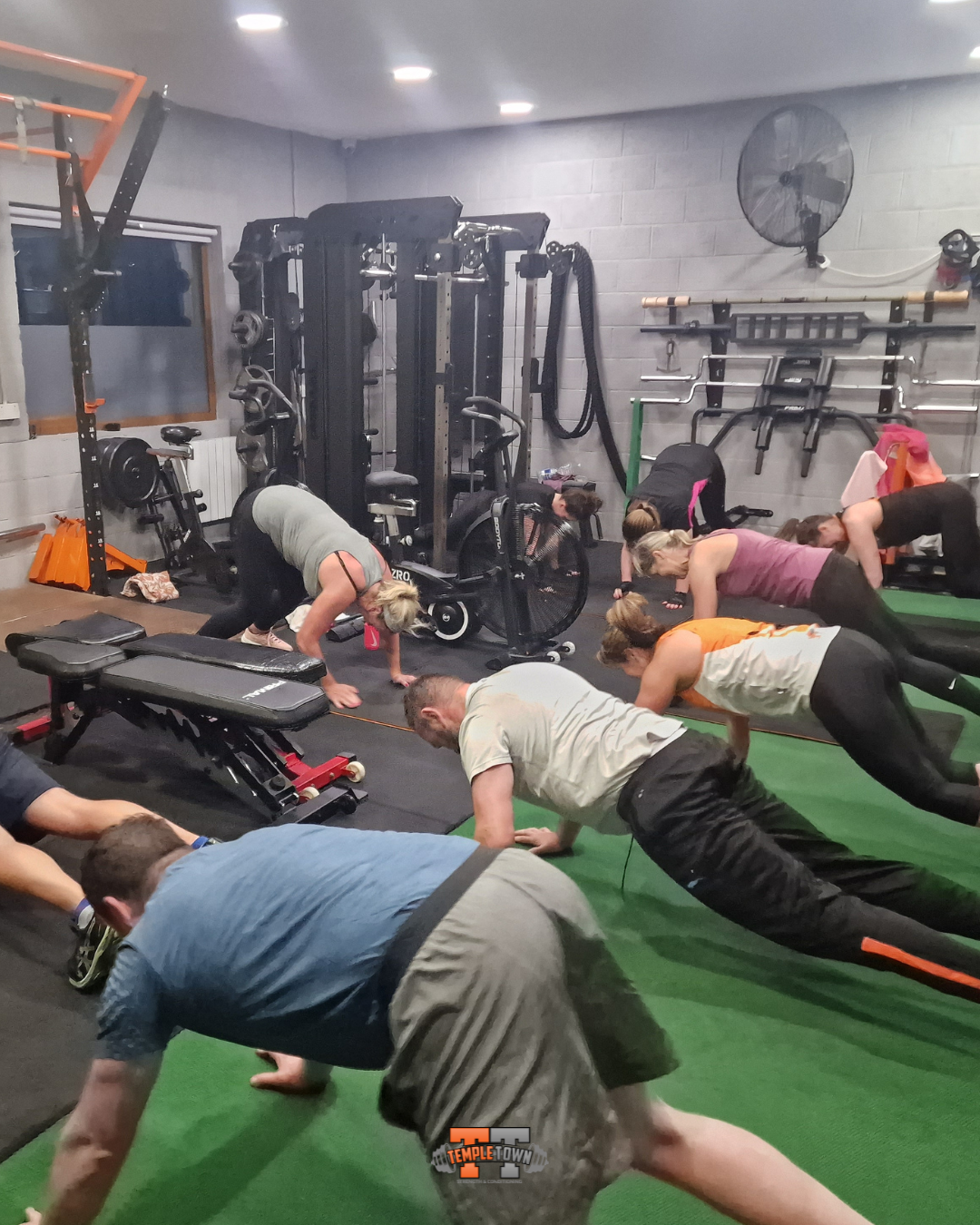
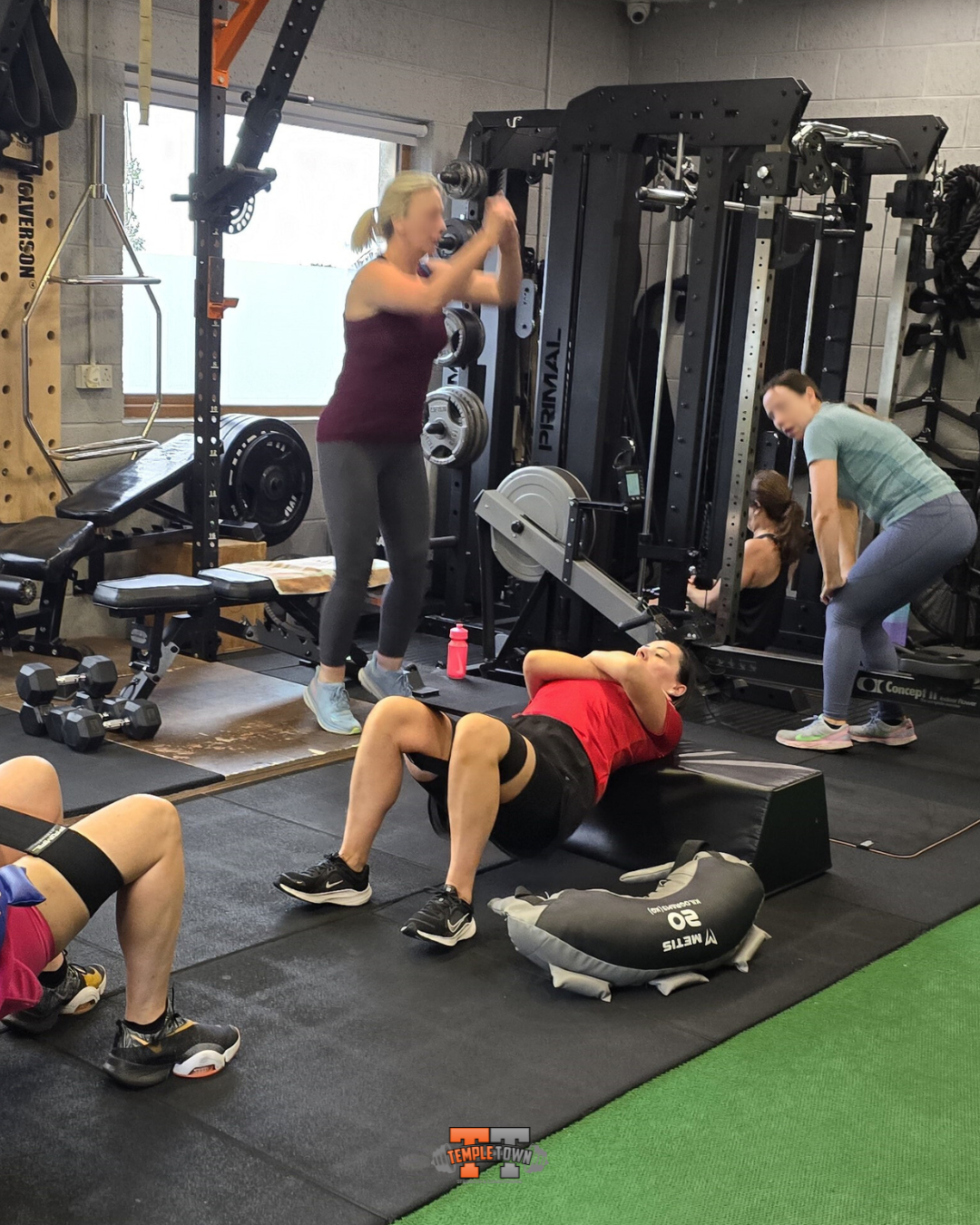
At Templetown SC in Carlingford, our small group coaching works because:
Your coach knows your goals – no anonymity, no hiding
Your coach notices your absence – accountability that matters
The same group trains together weekly – familiar faces, shared standards
Showing up matters – environment creates consequence
It’s not about guilt.
It’s about environment.
I see this every week here in Carlingford. Former GAA players, rugby lads, soccer players – they all think they’ve lost their discipline. They haven’t. They’ve just lost their structure.
Trap 3: Training Without Metrics (Competitors vs. Guesswork)
This one surprises people.
As an athlete, you tracked everything:
Times. Lifts. Performance markers.
You knew when you were improving.
Now?
You’re just “getting a sweat on.”
You train. You feel tired. You hope it’s working.
But without metrics, you’re guessing.
And competitors hate guessing.
You’re confusing tiredness with progress.
They are not the same thing.
The Fix
Measure what matters.
At Templetown SC, we establish:
Baseline Metrics
- Strength benchmarks
- Body composition
- Movement quality
Session Tracking
- Load
- Reps
- Sets
- Progression
Scheduled Retesting
- Body composition every 4 weeks
- Performance testing every 12 weeks
You don’t just hope you’re stronger.
You know you are.
That clarity rebuilds confidence.
One of my clients said to me a few months ago: “This is the first time in five years I’ve actually known I was getting stronger. Not hoped. Known.”
What Actually Works: The System
If you’re stuck in the start-stop cycle, here’s what changes everything:
1. Structured Programming
Periodised. Progressive. Built for longevity.
Not random workouts. Not just “smashing yourself.” Intelligent programming that adapts to your life – work stress, travel, family commitments – without falling apart.
2. External Accountability
A coaching framework where attendance matters.
You don’t need more motivation. You need an environment where people notice if you’re not there.
3. Measurable Progress
Objective data that proves you’re improving.
Track load. Track body composition. Track performance benchmarks. You need to see progress, not just feel tired.
The Results
When you combine those three?
Niggles reduce – because you’re not just smashing yourself hoping it works
Strength climbs – progressive overload that’s measured and managed
Body composition improves – visible changes backed by data
Consistency returns – showing up becomes automatic, not effortful
And most importantly?
You stop feeling like a watered-down version of who you used to be.
Not reliving your 20s.
Rebuilding your edge.
Over the last 8 years here in Carlingford, I’ve worked with dozens of former players – rugby lads, GAA players, soccer players – who were stuck in the same cycle.
They thought they’d lost it. They hadn’t.
They just needed someone to point out what they were doing wrong and give them a structure that actually worked.
Who This Is For
This is for former competitors (30-45+) who:
- Keep starting and stopping training
- Are frustrated with recurring niggles
- Miss feeling capable
- Know they’re capable of more
My small group coaching programme at Templetown SC is specifically designed for you.
Here’s what you get:
- Structured, periodised strength programming (no guessing)
- Accountability from a coach who knows what you’re capable of
- Small group environment (max 6 people per session – this isn’t a class)
- Progress tracking every 4 weeks
- Coaching on nutrition, recovery and managing life stress around training
You train three times per week. You follow a plan. You see progress.
Who This Is NOT For
This isn’t for casual gym-goers.
This isn’t for people who want to “try it out” or “see how it goes.”
This isn’t for people who want bootcamp chaos or random sweaty sessions.
This is for people who are done drifting.
Former competitors who are ready to rebuild structure and reclaim their edge.
Ready to Rebuild Structure?
If that’s you, apply for small group coaching at Templetown Strength & Conditioning in Carlingford.
We build systems for former athletes who refuse to fade.
Apply for Small Group Coaching Here <<
I’m selective about who I work with. Limited spots available.
Check out these links for more Templetown SC content:
🎙 Listen to the Podcast: Episode 23 – The Three Traps Every Former Athlete Falls Into
Author Bio: Paul Hughes is the owner and head coach of Templetown Strength & Conditioning in Carlingford, Co. Louth. For the past 8 years, he’s specialised in coaching former athletes (30-50+) who want to reclaim their edge through structured strength training, intelligent programming and sustainable performance strategies. He competes in hybrid fitness events including TRYKA and understands exactly what it takes to perform at 40+.
Ready to Stop Winging It?
Apply for small group coaching at Templetown SC Limited spots available
Carlingford, Co. Louth