
How to Stay Consistent With Exercise When Life Gets Busy
Why consistency beats motivation when you’re trying to get fit after 30
It’s Monday morning.
You’ve decided this is the week you’re finally getting back into shape.
Gym three times.
Healthy meals.
Plenty of water.
Early nights.
The whole lot.
By Wednesday work has gone mental, one of the kids is sick and you’ve managed precisely one workout.
Thursday you’re wrecked.
Friday you’re thinking you’ll start properly again on Monday.
Sound familiar?
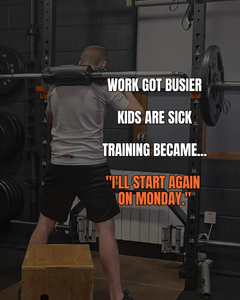
Here’s the thing.
You don’t have a motivation problem… You have a plan that only works when life goes perfectly.
And unless you’ve discovered some magical way of avoiding work, kids, stress and unexpected problems, that’s not going to happen very often.
Motivation is brilliant. Until it disappears.
Most people start a new fitness programme feeling motivated.
New gym gear.
New routine.
Maybe a holiday booked or a wedding coming up.
For the first week or two everything feels great.
Then the novelty wears off.
You get tired.
Work gets busy.
Progress slows down.
Suddenly the same workout that seemed exciting two weeks ago feels like another job on your to-do list.
And this is where people often assume they’re lacking discipline.
They’re not necessarily.
They’ve just built their entire approach around feeling motivated.
Motivation is a great way to start. It’s a terrible thing to depend on.
Stop Making The Perfect Week Your Minimum Standard
One of the biggest mistakes I see people make is planning their fitness around their best possible week.
They decide they’re going to train five days.
Walk 10,000 steps every day.
Cook every meal from scratch.
Cut out alcohol.
Get eight hours of sleep.
Lovely.
And who’s collecting the kids, answering the work calls and doing everything else?
The problem isn’t having ambitious goals.
It’s treating anything less than the perfect week as failure.
If you can train four times this week, brilliant.
If you can only manage twice next week, those two sessions still count.
Two workouts are infinitely better than the five you planned but never actually did.
Have a minimum standard for busy weeks
This is something I encourage with my own clients.
Rather than having one version of your programme that only works when everything goes right, have a backup.
For example:
Your normal week
- Three strength sessions
- Two walks or conditioning sessions
- Protein included in your main meals
- A consistent sleep routine
Your busy week
- Two full-body strength sessions
- Short walks whenever possible
- Simple meals built around protein
- Protect your sleep as much as you can
Your absolute nightmare week
- One 20 to 30-minute workout
- Keep moving where possible
- Don’t abandon your nutrition completely
- Get back to your usual routine when things settle
That’s not lowering your standards.
It’s making them realistic enough to maintain.
Because consistency isn’t about never missing a session.
It’s about not allowing one missed session to become three missed weeks.
Your training needs to fit your actual life
If you’re working full-time, raising a family and trying to have some sort of social life, you probably don’t have two hours a day to spend in the gym.
And you don’t need them.
For most adults getting back into training, two or three well-structured strength sessions per week can be an excellent starting point.
Focus On The Basics
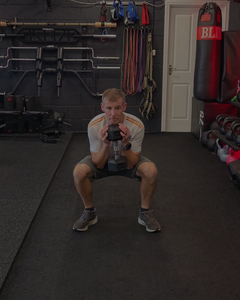
Squat.
Hinge.
Push.
Pull.
Carry.
Build strength gradually.
Add some cardiovascular work.
And stop changing your programme every time somebody on Instagram discovers a new exercise.
You don’t need endless variety.
You need enough consistency to actually get better at something.
Nutrition needs the same approach
It’s the same story with food.
You eat well Monday to Thursday.
Friday arrives.
A takeaway.
A few drinks.
A meal out.
And suddenly the whole weekend is written off.
Then Monday becomes another fresh start.
Instead, focus on habits you can maintain.
Get enough protein.
Eat fruit and vegetables regularly.
Keep an eye on portions.
Plan ahead when you know you’ll be busy.
Enjoy meals out without turning the entire weekend into an eating competition.
You don’t need perfect nutrition to lose body fat.
You need an approach that creates progress over time.
And that includes Fridays, Saturdays and Sundays.
Unfortunately, calories haven’t yet agreed to take weekends off.
Recovery isn’t optional either
Training is only one part of the picture.
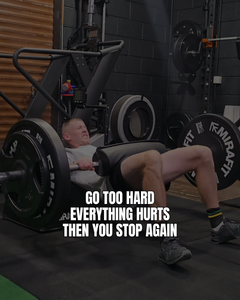
If you’re constantly stressed, sleeping five hours and trying to compensate with harder workouts, you’re making things unnecessarily difficult.
Your training, nutrition, supplements, stress management and mobility all contribute to the bigger picture.
Supplements can be useful in the right circumstances but they won’t rescue a poor routine.
Stretching and mobility can help you maintain movement options but they’re not a substitute for building strength.
And sometimes the most productive thing you can do is get an earlier night rather than squeezing in another exhausting workout.
The goal is to improve your life.
Not create another source of stress.
Give Yourself Something Worth Working Towards
One thing I’ve noticed with people who used to play sport is that training becomes harder when there’s no longer a reason behind it.
You used to train for matches.
For performance.
For your teammates.
Now the goal might simply be to lose a bit of weight.
There’s nothing wrong with that.
But it can help to have something more meaningful to work towards.
Maybe it’s getting strong enough to do your first proper push-up.
Maybe it’s running 5km without stopping.
Maybe it’s getting back to five-a-side.
Maybe it’s being able to lift, hike or play with your kids without feeling wrecked afterwards.
You just need a reason to keep showing up.

For me, one of those challenges happens to be the Lisbon Marathon this Saturday.
Whether the last 10km agrees with my training philosophy remains to be seen.
But you certainly don’t need to run a marathon.
The real secret is making it repeatable
The people who get the best long-term results aren’t necessarily the ones who train the hardest.
They’re the ones who find a way to keep training when life isn’t perfect.
They have a plan.
They know what matters.
They adjust when needed.
And when they miss a session, they don’t throw the whole programme in the bin.
They simply get back to it.
Stop asking yourself how to get more motivated.
Start asking how to make your training easier to stick with.
Because the best programme isn’t the one that looks impressive on paper.
It’s the one you can actually follow.
Ready To Get Back Into Training?
At Templetown Strength & Conditioning, I help busy adults build strength, lose body fat and improve their fitness without their entire lives revolving around the gym.
Whether that’s through Small Group PT in Carlingford or personalised online coaching, the goal is the same.
Build a programme that works for your life.
Not somebody else’s.
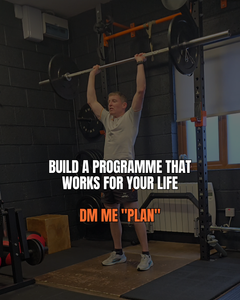
If you’ve been stuck in the start-stop cycle, message me the word PLAN and tell me what’s been getting in your way.
Paul Hughes
Templetown Strength & Conditioning